Build a Python Web Scraper Powered by GPT-5.4-Nano
Developers can now build a streamlined Python web scraper that uses OpenAI's gpt-5.4-nano model to extract clean, query-specific markdown answers while drastically reducing token costs.
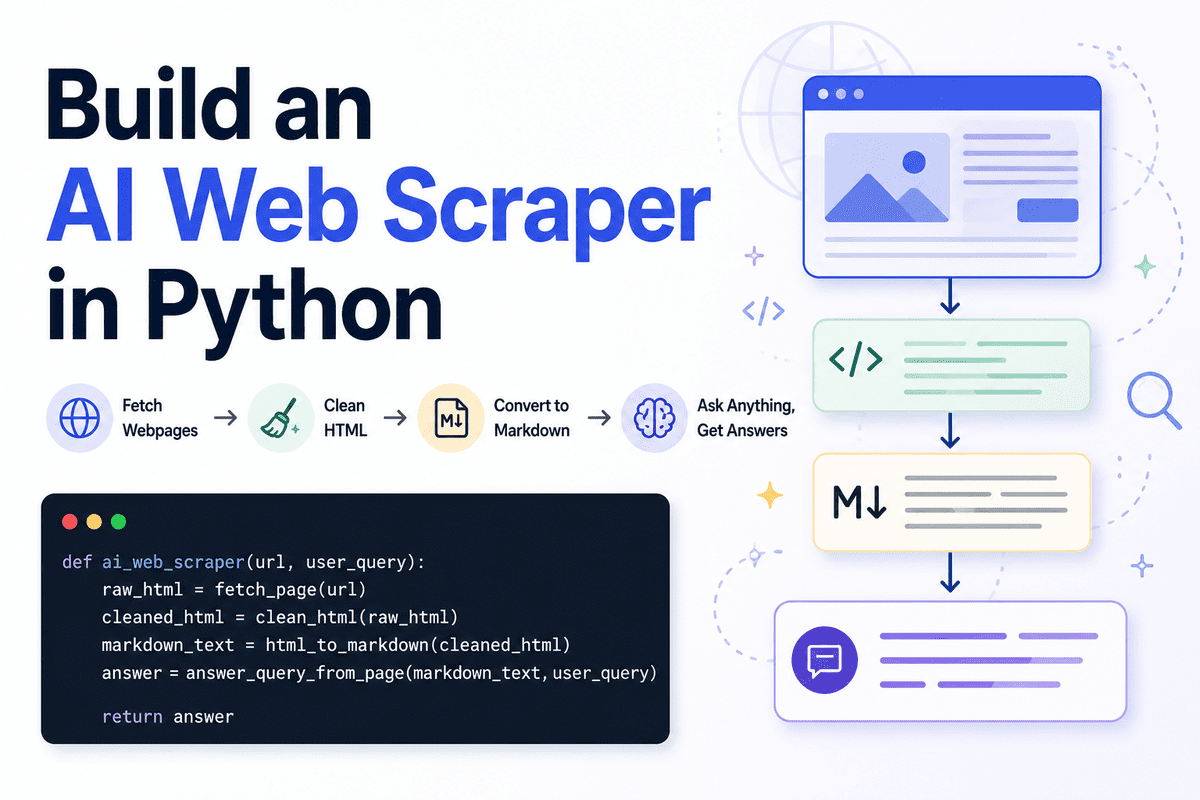
A new tutorial demonstrates how to construct a lightweight, AI-powered web scraping pipeline in Python using Jupyter Notebook and OpenAI's gpt-5.4-nano model. By cleaning raw HTML and converting the remaining text into Markdown before sending it to the large language model, this approach allows developers to build a highly focused question-answering engine. This method significantly reduces input token usage by stripping out unnecessary webpage elements like navigation menus, footers, and scripts.
The pipeline relies on a stack of standard Python libraries, including requests, beautifulsoup4, markdownify, openai, ftfy, and python-dotenv. First, the requests library fetches the target webpage with a 15-second timeout and a custom User-Agent header to prevent blocking. Next, BeautifulSoup parses the raw HTML to purge noisy tags such as script, style, noscript, svg, img, iframe, nav, header, footer, aside, form, and button. It also filters out elements containing class names or IDs with distracting keywords like popup, cookie, navbar, newsletter, or modal.
Once the HTML is clean, markdownify converts the remaining structure into Markdown using the ATX heading style. Regular expressions then strip out image links, collapse multiple spaces, and limit consecutive blank lines to a maximum of two. The cleaned Markdown is then passed alongside a user query to the gpt-5.4-nano model. A system prompt instructs the model to answer the query using only the provided page content, ignoring promotional call-to-action text or decorative fragments, and to output the final response in clean Markdown.
For AI practitioners, this custom pipeline offers a cost-effective way to feed clean web data into agentic workflows without paying for heavy reasoning models. However, building and maintaining custom scrapers involves ongoing costs and development time. For larger or more complex projects, developers may still want to evaluate established commercial web intelligence APIs and scraping platforms such as Olostep, Firecrawl, or Exa.
This is our own summary of reporting by KDnuggets