Meta Debuts Muse Glimmer 30B for Local AI Agents
Meta AI Research has open-sourced Muse Glimmer, a 30-billion-parameter model designed to run complex autonomous agents locally on consumer hardware without relying on cloud APIs.
Meta AI Research has launched Muse Glimmer, an open-weight 30-billion-parameter model under the Apache 2.0 license. Built for local, always-on workflows, the model allows developers to run autonomous agents, execute local coding, and perform LLM-as-a-judge evaluations directly on workstations. To build Muse Glimmer, Meta transferred reasoning capabilities from its larger Muse Spark flagship model using logit distillation, followed by mid-training on long-context sequences and post-training alignment. A built-in 1.8-billion-parameter perception encoder also lets the model process multimodal inputs like screenshots and diagrams natively.
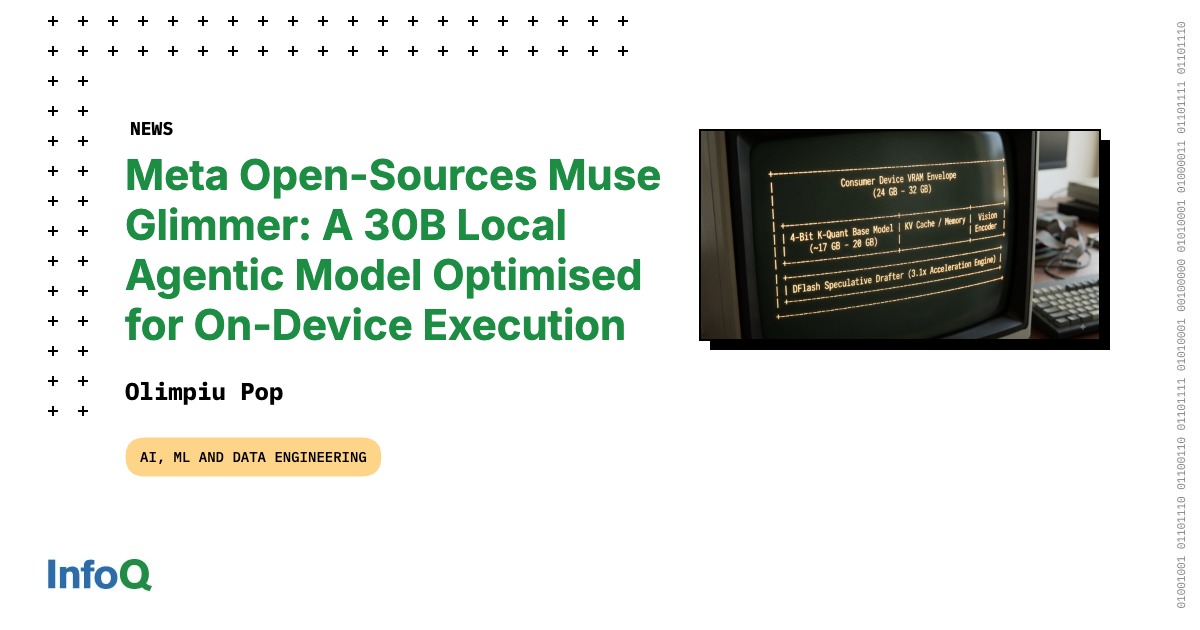
Running a standard 30-billion-parameter model typically requires more than 55 GB of VRAM, but Muse Glimmer uses dynamic 4-bit K-Quant quantization to shrink its footprint to between 17 GB and 20 GB. This allows it to run within standard 24 GB to 32 GB GPU or NPU memory budgets, leaving room for the key-value cache and speculative decoding. To boost speed, the model pairs with a companion drafter model using DFlash speculative decoding, which delivers up to a 3.1x increase in generation throughput on hardware like Apple M4 or M5 Max chips and NVIDIA RTX 5090 cards.
Designed for long-horizon planning, Muse Glimmer can diagnose terminal or API errors and try alternative paths rather than failing. It supports agent frameworks like OpenClaw and features adjustable reasoning effort. In benchmark tests including SWE-Bench, DeepSearch QA, τ-Bench, and MCP-Atlas, Muse Glimmer demonstrated better multi-step tool reliability and failure recovery than rival models like Gemma 4 31B and Qwen 3.6 27B.
For developers, this release makes high-capability local AI agents highly viable, protecting data privacy while ensuring low-latency execution. The model weights are hosted on Hugging Face, with native support for local runtimes like llama.cpp, ExecuTorch, Apple MLX, Ollama, LM Studio, and vLLM. Developers can also fine-tune the model using PyTorch's TorchTitan framework on consumer setups equipped with an RTX 4090 or RTX 5090.
This is our own summary of reporting by InfoQ AI