Simon Willison Builds CORS Chat Web UI for Local APIs
Independent developer Simon Willison has built CORS Chat, a browser-based web interface that lets developers interact directly with any OpenAI-compatible API endpoint supporting CORS.
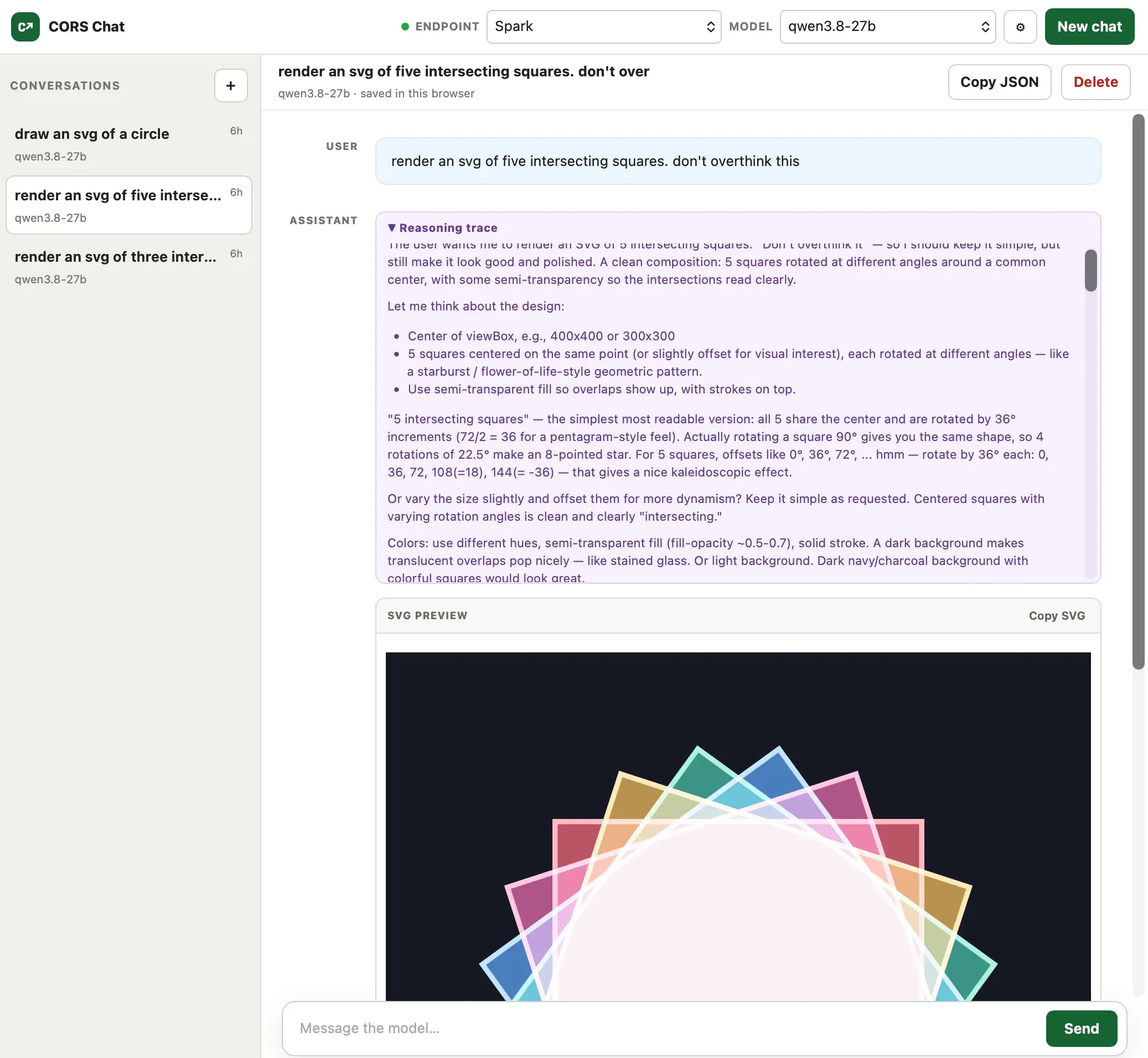
Independent developer Simon Willison has created CORS Chat, a browser-based user interface designed to interact directly with any OpenAI-compatible API endpoint that supports Cross-Origin Resource Sharing (CORS) headers. Willison built the tool using the GPT-5.6-Sol xhigh model to assist in testing local and remote language models. The application runs entirely within the user's browser, allowing developers to configure endpoints with custom headers and manage multiple chat sessions with different models and reasoning settings.
To demonstrate its utility, Willison tested the tool against the Qwen 3.8 27B model running in LM Studio. These tests were conducted on both a personal Apple M5 MacBook Pro and an enterprise-grade NVIDIA DGX Spark system. The interface also successfully connects to OpenRouter and LM Studio when the latter is launched with the --cors flag enabled, proving its versatility across different hosting environments.
CORS Chat includes several developer-friendly features, such as local conversation persistence within the browser and the ability to export chat histories as copy-pasted JSON. Additionally, the tool features a unique rendering capability: it detects SVG images as they are being generated by the model and progressively renders them in the chat window while the tokens are still actively streaming in real time.
For AI practitioners, this lightweight tool simplifies the process of testing and interacting with various self-hosted or cloud-based models without needing to deploy complex frontend stacks. By bypassing the need for intermediary servers, developers can quickly swap between different models, adjust reasoning settings, and debug API responses directly from their local environment. This makes it an efficient utility for rapid prototyping and model evaluation.
This is our own summary of reporting by Simon Willison