New Method Erases Copyrighted Characters in Stable Diffusion
Chinese researchers have developed a non-invasive method to replace copyrighted characters with generic doubles during AI image generation, protecting IP without degrading model performance.
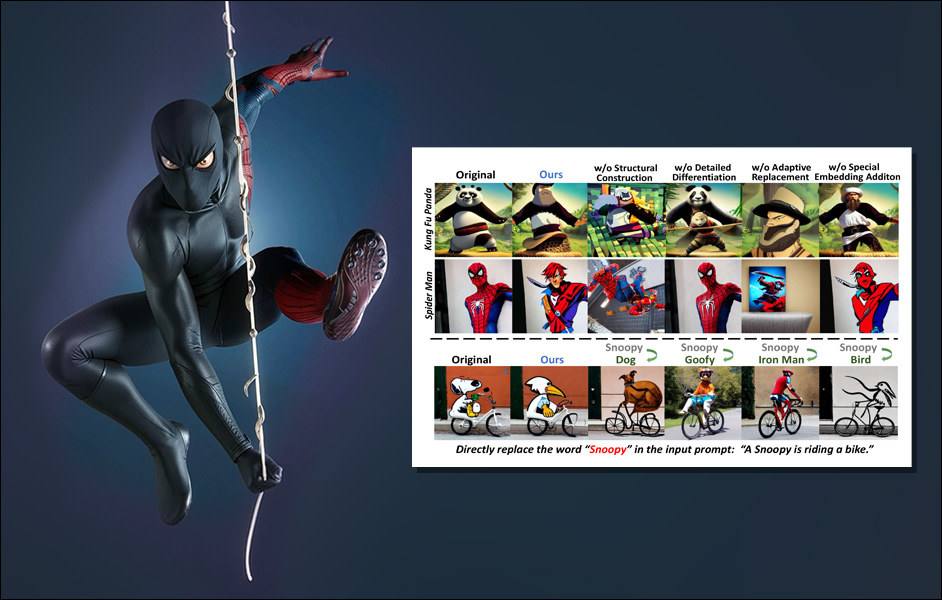
Researchers from the Chinese Academy of Sciences have introduced a novel technique to prevent generative AI models from outputting copyrighted animation characters. Detailed in a new paper, the method injects optimized semantic anchors into the inference process. These anchors act as generic visual surrogates, retaining the broad shape and layout of a character while stripping away its legally protected details. Because this process occurs entirely during generation, it requires no fine-tuning or direct modification of the underlying model weights.
The research team tested their approach using Stable Diffusion v1.4 as the primary baseline, alongside versions v1.5, v2, v2.1, XL base 1.0, and the DiT-based Z-Image. They compiled a dataset of 80 animation characters, including 36 anthropomorphic, 23 animal-form, and 21 miscellaneous figures. Using prompts generated by GPT-4o, they produced 100 images per character. The researchers compared their method against five prompt-based baselines, including Safe Latent Diffusion, STG, SAFREE, TraSCE, and Negative Prompting, and integrated it into four model-modification frameworks: MACE, UCE, ESD-u, and AC.
The proposed method outperformed existing baselines in both character erasure and image quality. Evaluation via LLaVA-1.5 and BLIP-3 showed that target identification accuracy fell to just 6.0% and 4.0%, representing improvements of 3.5% and 1.7% over the second-best baseline. The system also preserved background structures effectively, achieving a Structural Similarity Index of 0.467, a Learned Perceptual Similarity Metric of 0.505, and an Aesthetic Predictor V2 Score of 5.18.
For AI practitioners and platform operators, this development offers a highly flexible, plug-and-play solution for copyright compliance. Instead of permanently damaging a model's latent space through destructive ablation, developers can deploy these anchors at the API level. The method allows granular, continuous control over the erasure strength by interpolating between the anchor and the original target embedding at steps like 0.25, 0.5, and 0.75. This ensures that background elements remain stable and free of the warping or blurring artifacts that typically plague negative prompting.
This is our own summary of reporting by Unite.AI


