Stream NVIDIA Cosmos3-DROID to Train Robotics Models
Developers can now train robotics models by streaming the 707 GB NVIDIA Cosmos3-DROID dataset directly, eliminating the need for massive local storage.
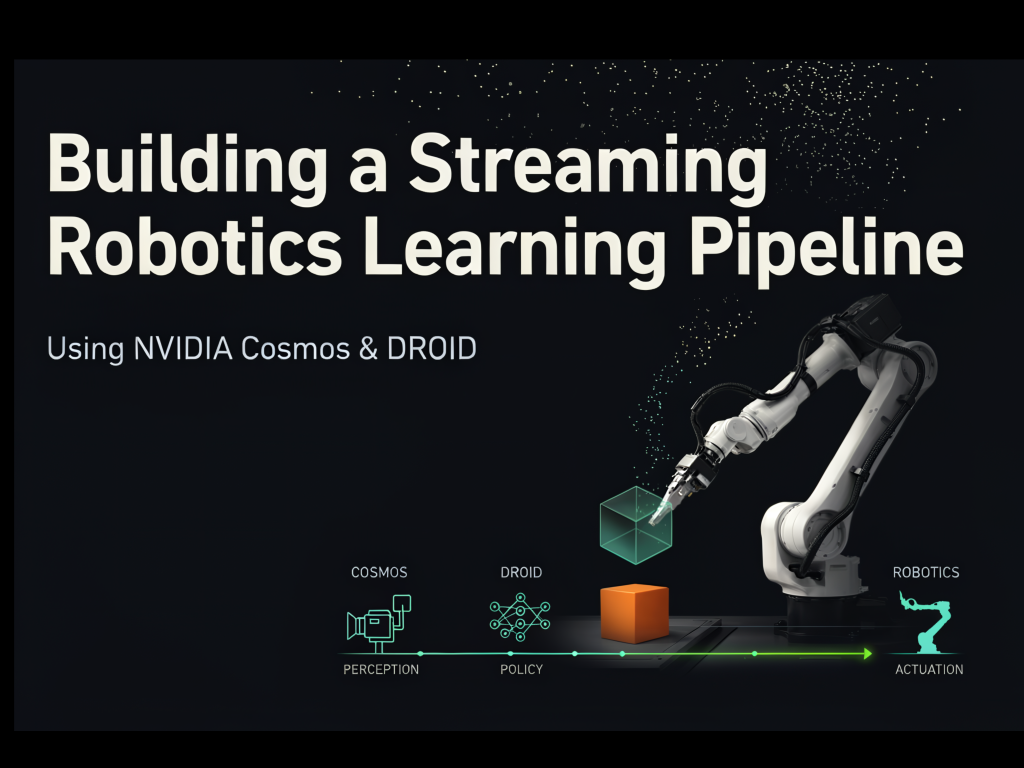
A new technical walkthrough details how to construct an end-to-end streaming robotics learning pipeline using the NVIDIA Cosmos3-DROID dataset. Instead of downloading the massive 707 GB repository locally, the method streams data directly from Hugging Face, keeping peak disk usage to just a few hundred megabytes. This approach makes training advanced robotics models accessible to practitioners without massive local storage arrays.
The pipeline begins by analyzing the LeRobotDataset v3.0 structure. It builds a metadata graph using info.json, task metadata, episode tables, and dataset statistics. By employing HTTP byte-range access with PyArrow, the system selectively reads Parquet row groups and columns. It converts individual episodes into state-action trajectories to analyze joint motion, gripper events, Cartesian end-effector paths, and action-frequency spectra. To handle visual data, the pipeline decodes only the necessary AV1 video windows using seek-based PyAV or FFmpeg access, avoiding full video downloads.
After normalizing observations and actions with dataset statistics, the pipeline constructs an ACT-style chunked PyTorch dataset. The architecture features a chunked policy that combines an MLP state encoder with an optional CNN vision encoder. Training is optimized using AdamW, OneCycle learning-rate scheduling, mixed-precision execution, and a Smooth L1 loss to handle noisy teleoperation actions. Practitioners can scale this setup across 53,086 task strings, alternative camera views like exterior_image_1_left, or 14,268 negative episodes from the failure directory.
Finally, the pipeline evaluates the learned policy through an open-loop rollout using temporally ensembled action chunks. It measures performance by reporting per-joint mean squared error (MSE) and R^2 against a mean-action baseline. The workflow visualizes predicted versus ground-truth actions and saves the complete policy checkpoint as a portable file for downstream applications.
This is our own summary of reporting by MarkTechPost