Convai Innovations Launches Laya Decision Engine
Convai Innovations has released Laya, an open-source decision engine that offers developers a fast, calibrated alternative for zero-shot text classification without generating tokens.
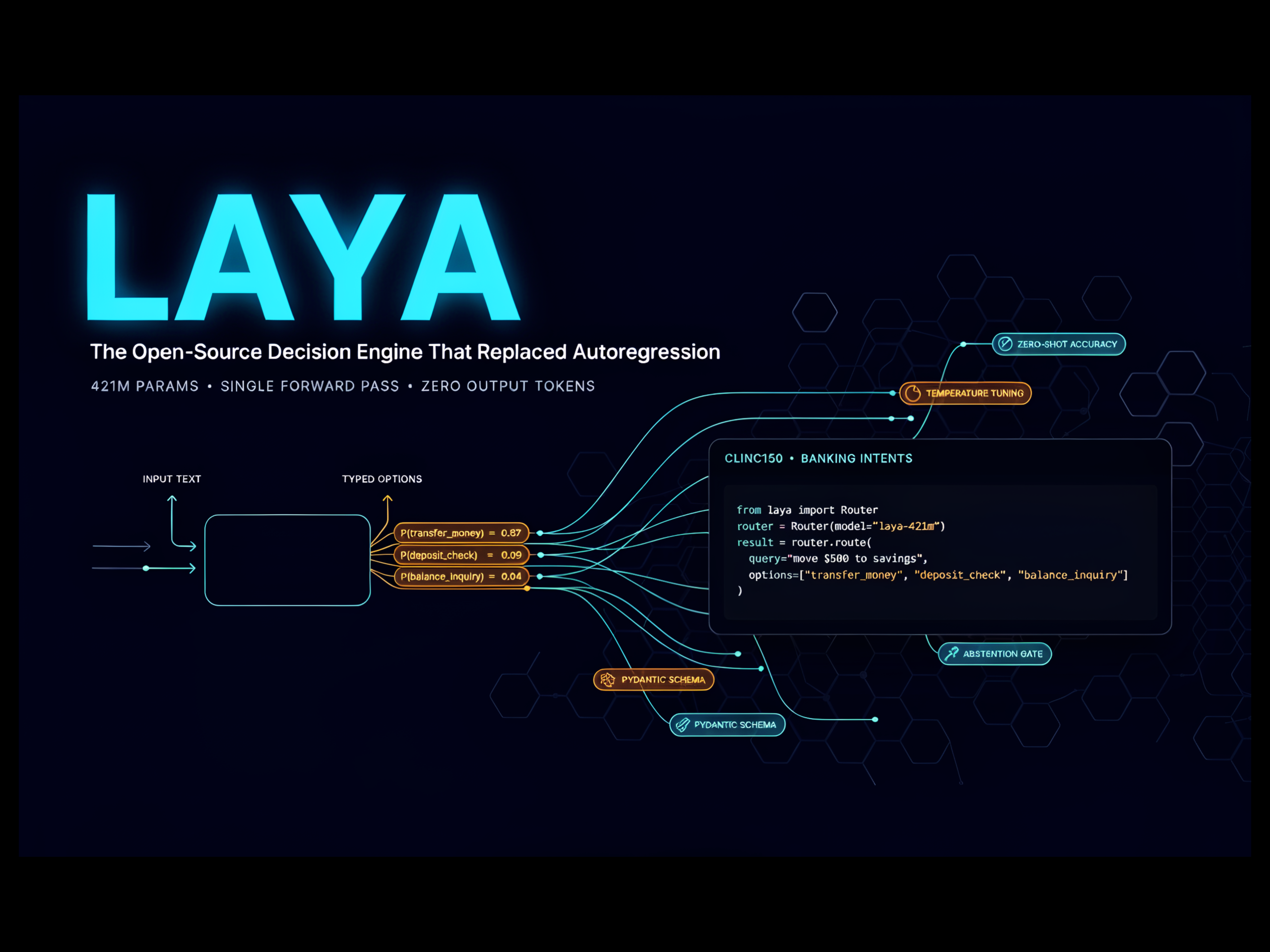
Convai Innovations has released Laya, an open-source decision engine that emerged as a highly starred machine-learning repository in September 2026. As a non-autoregressive System 1 model, Laya utilizes a 421-million-parameter encoder to evaluate text alongside typed questions, such as multiple-choice options or binary queries. Rather than generating text, the model returns calibrated probabilities for each option in a single forward pass with zero output tokens, positioning itself as an open-source alternative to TypeSafe's Jev.
In evaluations using the banking domain of the CLINC150 intent dataset, which features 15 intents, Laya demonstrated strong zero-shot capabilities. When provided with bare intent names, the model achieved a zero-shot accuracy of 0.878 on 450 test queries. This outperformed a classic TF-IDF and logistic regression classifier trained on three labeled examples per intent, which scored 0.651, and rivaled the same classifier trained on ten examples, which reached 0.848. However, reversing the option order flipped 4.2 percent of individual predictions, indicating a position prior.
Practitioners deploying Laya 0.3.27 should pay close attention to calibration. The model's shipped choice temperature for 11 or more options is 0.10, which the loader clamps to 0.5, resulting in over-confident predictions. On the test set, this yielded an expected calibration error of 0.102, with a mean confidence of 0.974 versus the actual 0.878 accuracy. Fitting a temperature of 1.258 using 300 validation records reduced the calibration error to 0.059. However, running the built-in temperature fitting function can reset unrepresented question types to 1.0, requiring developers to manually restore other shipped values.
Laya also supports abstention gates to manage error budgets. A gate fitted to a 5 percent validation error target selected a confidence threshold of 0.602, though this realized a 9.2 percent error rate on the harder test set. This highlights the need for practitioners to build in safety margins and periodically re-fit thresholds on real traffic. Additionally, because each question is processed as a separate row while options share a single row, developers should design single choice questions with many options rather than multiple yes-or-no queries to optimize latency.
This is our own summary of reporting by MarkTechPost